THE STORY BEHIND THE NAME521 / 528
Vilanova
Avinguda de Vilanova
13th–14th centuriesMedicine, learning, and dissent
A physician in the courts of the Mediterranean.
The avenue honours Arnau de Vilanova, rather than the town of Vilanova i la Geltrú.
FROM THE VISUAL RECORD
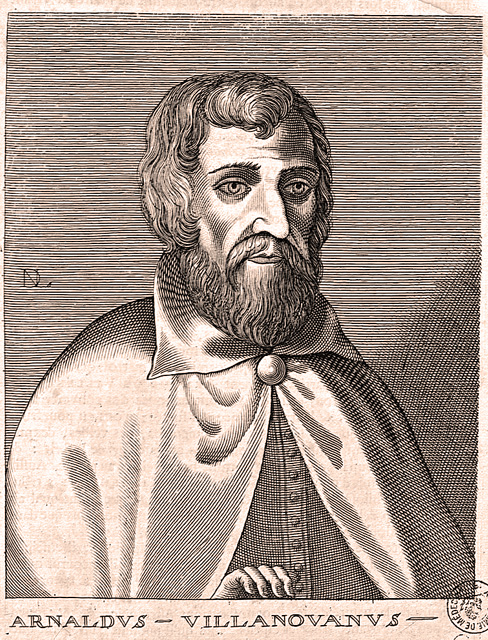
Arnau de Vilanova, in a later historical engraving.
Unknown derivative work by JPS68 · Public domain · Source IN BALAGUER’S TELLING
Balaguer identifies a renowned physician and philosopher, recounting his learning, travels, service to rulers, and conflicts over his teachings. His account includes older assumptions about Arnau’s birthplace, chronology, and writings; those details need to be distinguished from the identification behind the dedication. He describes condemnation by the University of Paris and refuge under Frederick of Sicily. The physician becomes, in Balaguer’s argument, an example of intellectual freedom threatened by religious persecution.
THE BARCELONA CONNECTION
Balaguer places Arnau’s medical practice in Barcelona in 1285, when he was summoned to attend the dying Peter the Great at Vilafranca del Penedès. The avenue commemorates this physician and thinker, whose teaching and writings also connected Montpellier and the courts of the Crown of Aragon. Balaguer’s broader chronology and birthplace claims require separate caution.
FROM THE ORIGINAL PAGES
“After teaching in France to great acclaim, he returned to his homeland. In 1285, the year Peter the Great died, he was practising medicine in Barcelona, from where he was summoned to attend the king’s final illness at Vilafranca del Penedès.
From «Vilanova (calle de)» · vol. 3, p. 291 · 1888 · English translation
Read Balaguer’s complete street entry WHY THIS CATEGORY?
People: Vilanova honours the physician and thinker Arnau de Vilanova, rather than Vilanova i la Geltrú. This explains its People category.
A city read through a nineteenth-century book. About our sources

 BARCELONA