THE STORY BEHIND THE NAME292 / 528
Llull
Carrer de Llull
THEN & NOWShown on the nearby surviving continuation east of the Ciutadella. Balaguer envisaged a route across land then occupied by the fortress; that route was transformed by the park.
13th–14th centuriesFaith, reason, and Catalan prose
A language capable of philosophy.
Ramon Llull connects Mallorca with a vast intellectual project written across several languages.
FROM THE VISUAL RECORD
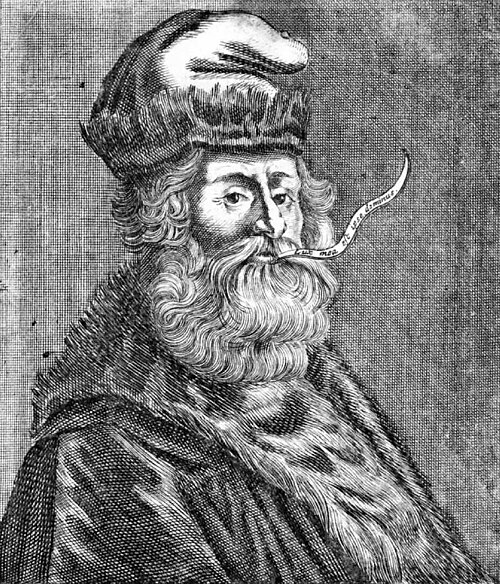
A historical representation of Ramon Llull.
unknown (from the collection of Friderici Roth-Scholtzii Noriberg) · Public domain · Source IN BALAGUER’S TELLING
Balaguer recounts Llull’s conversion, travels, scholarship, and efforts to promote language teaching for Christian missionary work. He includes a dramatic conversion legend and traditional biographical details. These belong to his nineteenth-century telling and should not all be treated as securely documented episodes. The practical thread is his campaign for colleges teaching Arabic and other Eastern languages, equipping missionaries to debate Muslim scholars. Balaguer follows him petitioning rulers and popes to support that project.
THE BARCELONA CONNECTION
Llull’s philosophical and literary work helped make Catalan a language of complex intellectual argument. His missionary aims and methods belong to the religious conflicts of the medieval Mediterranean. The dedication links Mallorca’s cultural history with the literary revival that shaped Balaguer’s own Barcelona.
FROM THE ORIGINAL PAGES
“Ramon Llull left works of great importance as a poet and philosopher, among them his Ars Magna, one of the works that has made the greatest stir and won the most fame in the world. The Dominicans fiercely opposed his writings; his followers, however, formed a school, established teaching chairs and spread their master’s reputation, attracting distinguished adherents.
From «Lull (calle de)» · vol. 2, p. 236 · 1888 · English translation
Read Balaguer’s complete street entry WHY THIS CATEGORY?
People: Llull honours the writer and thinker Ramon Llull. People follows the individual; the modern street continuing beyond the park is distinct from Balaguer’s projected route through the Citadel area.
A city read through a nineteenth-century book. About our sources

 BARCELONA