THE STORY BEHIND THE NAME38 / 528
Ausiàs Marc
Carrer d'Ausiàs Marc
15th centuryThe poetry of late medieval València
A language larger than a border.
Barcelona honoured the Valencian poet Ausiàs March with a street in the Eixample, recognising a shared literary tradition in the Catalan language.
FROM THE VISUAL RECORD
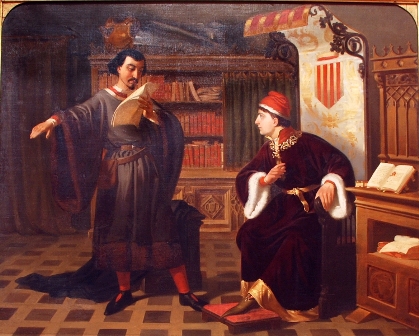
Ausiàs March and the Prince of Viana, imagined by Agustí Rigalt. A later literary scene, not an authenticated likeness of the poet.
Agustí Rigalt i Cortiella · Public domain · Source IN BALAGUER’S TELLING
Balaguer identifies Ausiàs March as a Valencian-born poet writing in Catalan. He praises the poems of love and mourning and lists editions printed in Barcelona, including a new edition by Francesc Pelai Briz in 1864. For him, language settles the question of literary belonging: March’s Valencian birthplace does not diminish his place in Catalan letters. He invokes repeated early editions as evidence of lasting readership.
THE BARCELONA CONNECTION
Barcelona honoured a poet from València as part of a shared Catalan-language literary tradition. Balaguer points to the city’s editions of his poetry, linking the medieval writer with the nineteenth-century revival that helped shape the Eixample’s street names.
FROM THE ORIGINAL PAGES
“Much has been written and researched to establish this famous poet’s birthplace, some claiming Valencia and others Catalonia. Yet there is no longer any doubt that he was Valencian by birth, though from a Catalan family. He is nevertheless rightly called a Catalan poet, because he wrote in Catalan and was born in lands then forming part of the Catalan nation. Today all who write in Castilian are called Spanish poets, whether Andalusian, Aragonese, Basque, Navarrese, Galician or Catalan. Ausiàs March composed his admirable songs in Catalan, and his glory belongs to Catalonia.
From «Ausias March (calle de)» · vol. 1, p. 112 · 1888 · English translation
Read Balaguer’s complete street entry WHY THIS CATEGORY?
People: The street honours the Valencian poet Ausiàs March and his place in Catalan literature.
A city read through a nineteenth-century book. About our sources

 BARCELONA