THE STORY BEHIND THE NAME444 / 528
Rosselló
Carrer del Rosselló
1659A divided historical landscape
The border that moved.
The map of today is not the map Balaguer had in mind. Rosselló looks north, toward a Catalan-speaking territory now in France.
FROM THE VISUAL RECORD
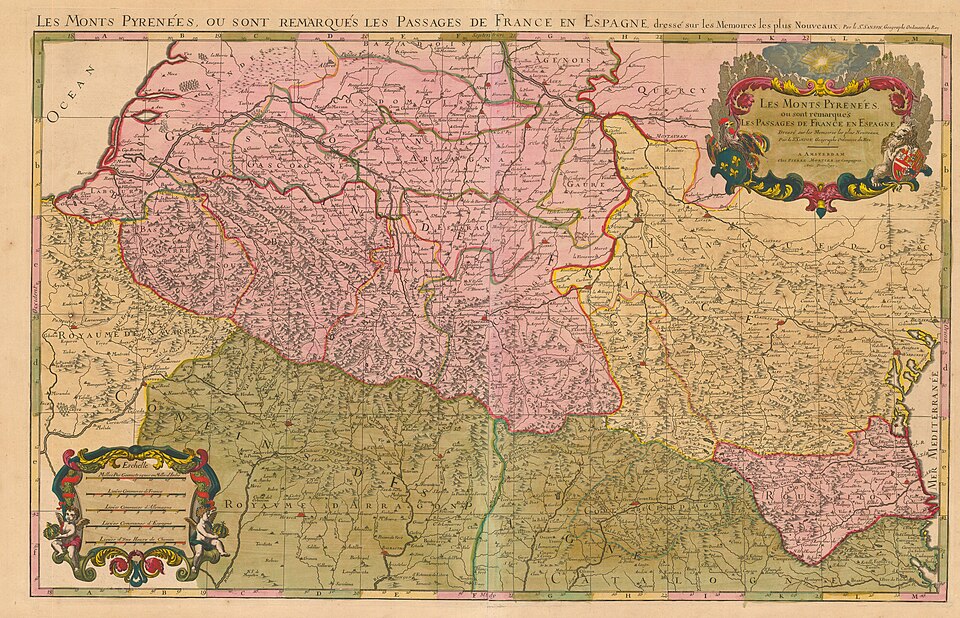
Roussillon and the Pyrenean frontier on a map by Nicolas Sanson and Alexis Hubert Jaillot, published after the Treaty of the Pyrenees.
Nicolas Sanson / Alexis Hubert Jaillot · Public domain · Source IN BALAGUER’S TELLING
Balaguer follows Roussillon through its counts, towns, institutions, and links with the kings of Aragon. He treats its place in Catalan history as sufficient reason for a major street to bear its name. The entry is an act of remembrance for a land beyond the contemporary Spanish border. He contrasts feudal violence with the Peace and Truce assemblies at Toluges, then ends with the Catalan language, dances and place names still familiar across the border.
THE BARCELONA CONNECTION
The county passed to the king of Aragon in the twelfth century. Much later, the Treaty of the Pyrenees of 1659 transferred Roussillon to France. Its name in Barcelona preserves the memory of historical ties that outlasted a change of sovereignty.
FROM THE ORIGINAL PAGES
“Such, in brief, is the history of a province which for centuries formed part of the Catalan nation. It is therefore hardly surprising that its name has been given to a street in remembrance.
From «Rosellón (calle del)» · vol. 3, p. 127 · 1888 · English translation
Read Balaguer’s complete street entry WHY THIS CATEGORY?
Places: Rosselló commemorates the historic county and territory, not a particular battle. This explains its Places category.
A city read through a nineteenth-century book. About our sources

 BARCELONA