THE STORY BEHIND THE NAME24 / 528
Aragó
Carrer d'Aragó
1137A dynastic union
Two lands, a shared crown.
This familiar cross-town artery carries the name of the kingdom whose union with the counts of Barcelona helped create a Mediterranean power.
FROM THE VISUAL RECORD
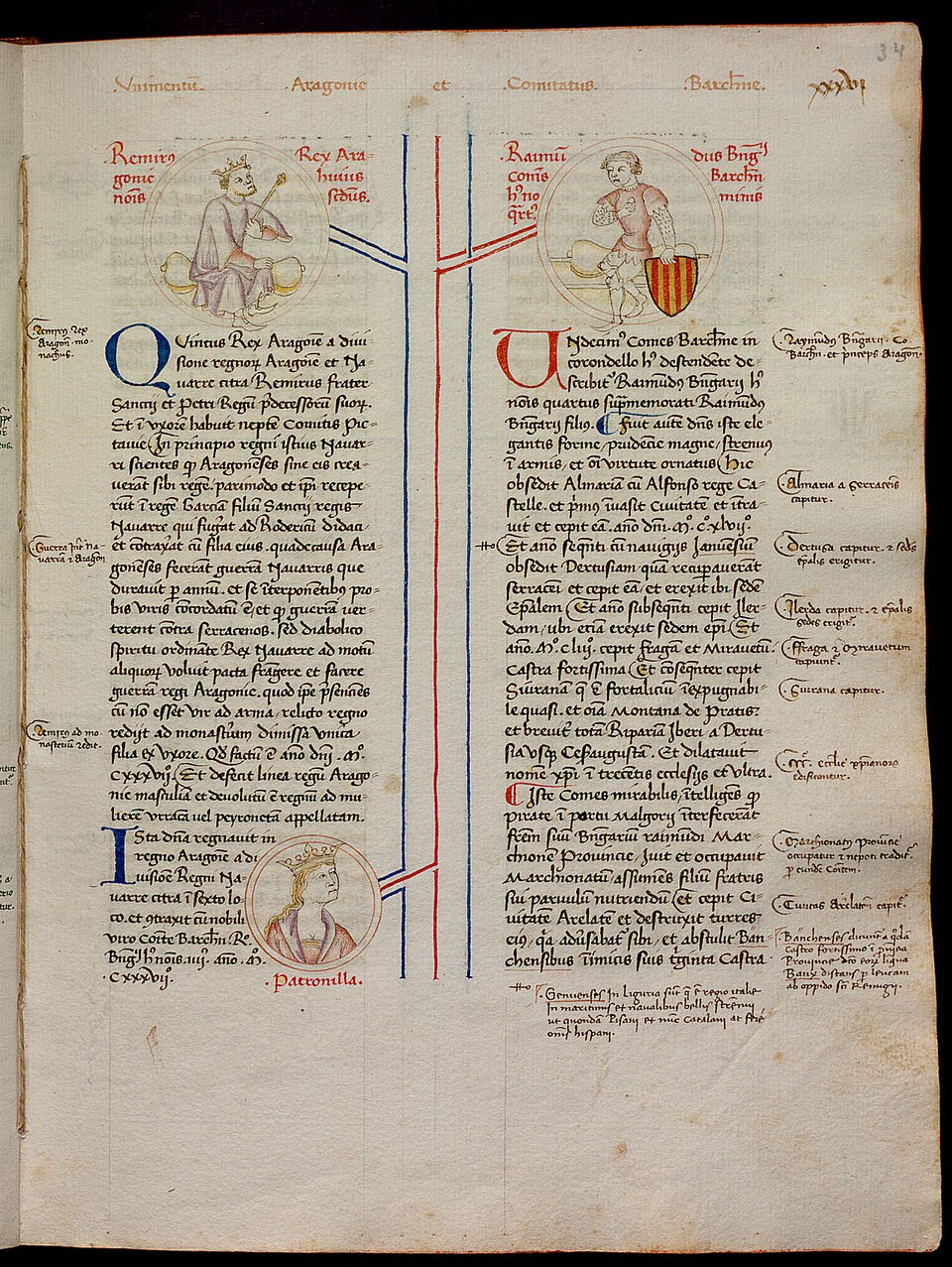
Dynastic imagery from Genealogies dels comtes de Barcelona, a manuscript dated 1450–1550.
Jaume Domènec · Public domain · Source IN BALAGUER’S TELLING
Balaguer presents Aragón as a reminder of the old Crown and the historical partnership of Aragon and Catalonia. In the 1888 edition, the entry also reproduces poems exchanged by Barcelona and Zaragoza on the opening of their railway connection: medieval memory meeting modern progress. He blames absolutism since 1714 for suppressing those memories. The poems imagine renewed fraternity through railways, industry and the arts, extending a shared military past into a peaceful future.
THE BARCELONA CONNECTION
The 1137 agreement joining Petronilla of Aragon and Ramon Berenguer IV of Barcelona laid the basis for the dynastic union. The Crown was a collection of territories with distinct laws and institutions, rather than a single uniform state. Its memory became a naming scheme for the Eixample.
FROM THE ORIGINAL PAGES
“The reason for this name is easy to understand: it recalls the old Crown of Aragon, of which Catalonia formed part. Giving Aragon’s name to a new street was intended to preserve the memory of that warlike land, once our sister, alongside which our ancestors accomplished such celebrated deeds.
From «Aragón (calle de)» · vol. 1, p. 89 · 1888 · English translation
Read Balaguer’s complete street entry WHY THIS CATEGORY?
Places: The name recalls Aragon and the territories of the Crown of Aragon, rather than one particular battle or ruler.
A city read through a nineteenth-century book. About our sources

 BARCELONA