THE STORY BEHIND THE NAME373 / 528
Parlament
Carrer del Parlament
Medieval assembliesThe estates of Catalonia
An assembly for an urgent moment.
The cafés of today sit on a name that Balaguer used to distinguish two forms of historical assembly.
FROM THE VISUAL RECORD
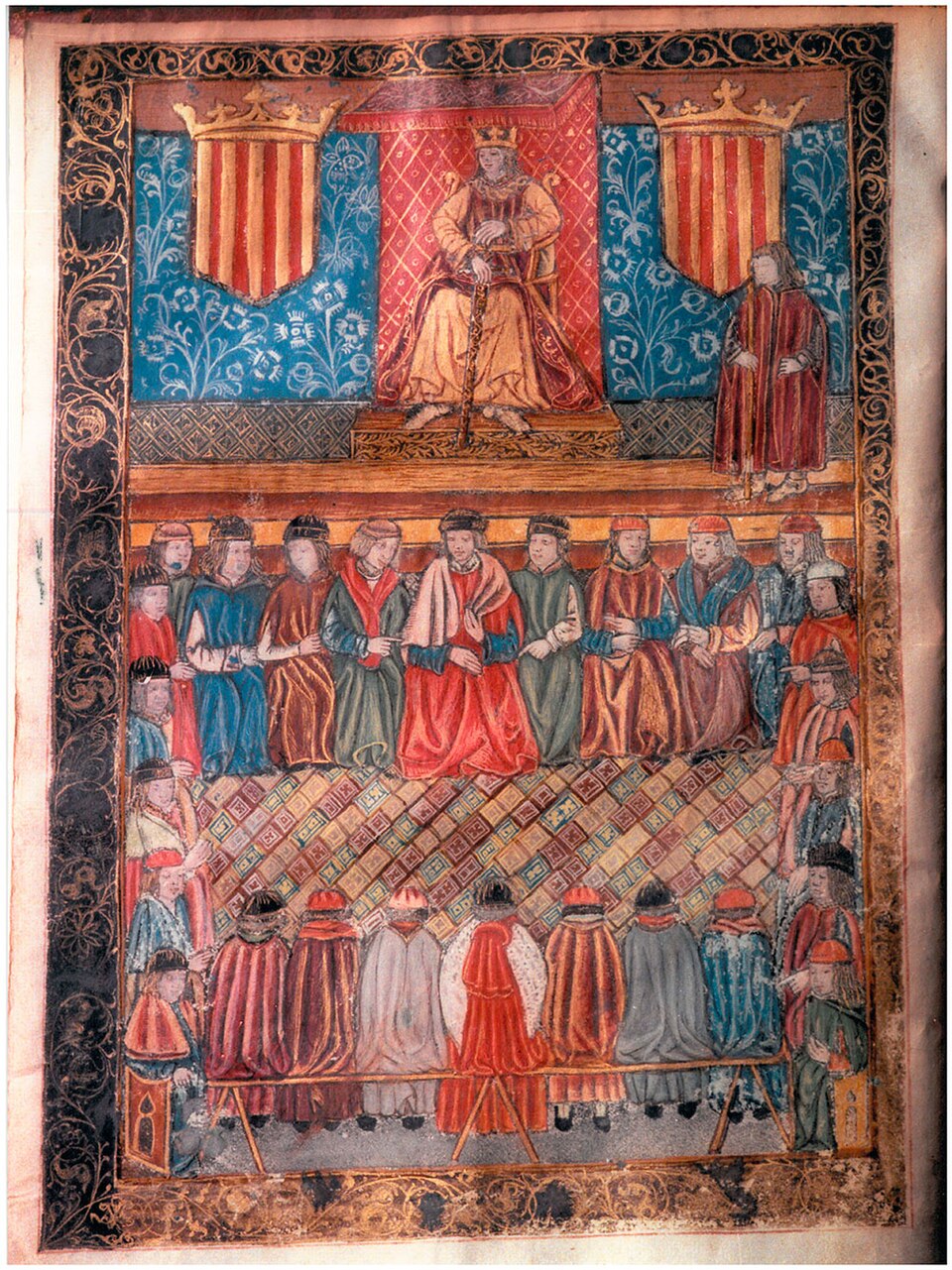
A historical representation of the Catalan Corts, illustrating the parliamentary tradition commemorated by this street.
Unknown creator · Public domain · Source IN BALAGUER’S TELLING
He dedicates the street to Catalonia’s old parliaments and carefully contrasts them with the Corts. In his account, a parliament could be called for an urgent particular matter, whereas the Corts had legislative authority and a different relationship with the monarch. He then illustrates how such assemblies proceeded. A governor or royal lieutenant could summon a parliament to seek advice on an immediate public problem. Balaguer reserves the making of laws to the Corts convened and presided over by the king.
THE BARCELONA CONNECTION
This is a nineteenth-century tribute to medieval political practices, rather than a dedication to the present Parliament of Catalonia. Read beside Corts Catalanes, Diputació, and Consell de Cent, it completes the four institutional names Balaguer explicitly grouped together in his explanation of the scheme.
FROM THE ORIGINAL PAGES
“This Eixample street is planned to run from the Ronda towards the gardens of Sant Beltran. It was named in memory of Catalonia’s old parliaments, a subject requiring some explanation after our longer discussion of the Corts.
From «Parlamento (calle del)» · vol. 2, p. 419 · 1888 · English translation
Read Balaguer’s complete street entry WHY THIS CATEGORY?
Institutions: Parlament commemorates Catalonia’s historical parliaments as political assemblies. Institutions follows those bodies, rather than a single session or an exclusive dedication to the modern Parliament.
A city read through a nineteenth-century book. About our sources

 BARCELONA