THE STORY BEHIND THE NAME369 / 528
Pallars
Carrer de Pallars
THEN & NOWThe visible modern street lies beyond the park area through which Balaguer originally imagined this grid route passing.
15th centuryThe Catalan Civil War
A name chosen for a rebel count.
Although it looks like another territorial name, Balaguer’s explanation centres on a person.
FROM THE VISUAL RECORD
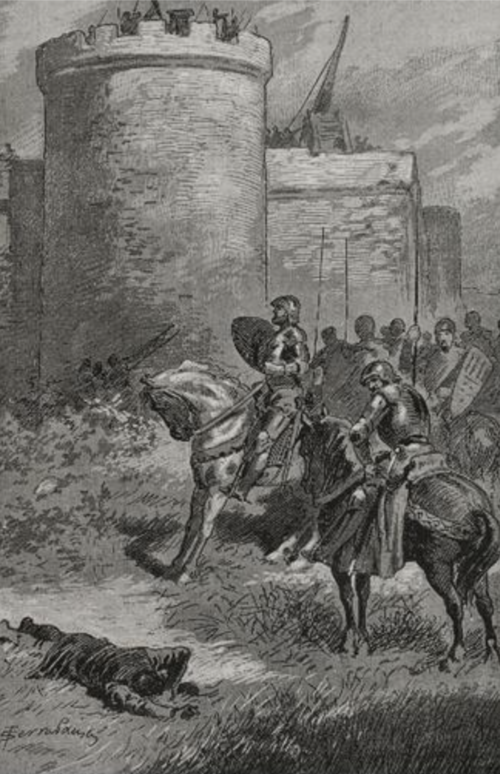
The attack on Gironella by the count of Pallars during the Catalan Civil War, in a later illustration.
Joan Serra y Pausas · Public domain · Source IN BALAGUER’S TELLING
He says he had principally in mind Hug de Pallars, the commander who opposed John II. He praises his refusal to submit after the Catalan cause was defeated, and admits that he lacks enough evidence to write the biography he would like to provide. He follows Hug from exile back to his own domains, gathering men to continue fighting. For Balaguer, refusing a king already deposed by the Catalan estates is a matter of political principle.
THE BARCELONA CONNECTION
The dedication recalls Hug Roger III (Catalan) and the conflicts surrounding royal power and the county of Pallars. Balaguer reads resistance through his own liberal patriotism. The distinction between a county, a dynasty, and an individual is part of what makes this apparently simple street name worth pausing over.
FROM THE ORIGINAL PAGES
“It will bear the name of a family celebrated in Catalan history. In choosing it, we particularly intended to recall Hug de Pallas—or, more correctly, Pallars—commander of the Catalan forces in the Principality’s war against King John II, a notable conflict and period in our history.
From «Pallars (calle de)» · vol. 2, p. 415 · 1888 · English translation
Read Balaguer’s complete street entry WHY THIS CATEGORY?
People: Balaguer explicitly intended the Pallars family and especially Hug de Pallars, the commander resisting John II. People follows the family and individual, rather than the county whose name they bore.
A city read through a nineteenth-century book. About our sources

 BARCELONA