THE STORY BEHIND THE NAME266 / 528
Passeig de Sant Joan
In the book: Juan (paseo de San)
THEN & NOWThe map shows today’s Passeig de Sant Joan, from Arc de Triomf towards Gràcia. The older Passeig Nou ran inside the walls, roughly along today’s Carrer del Comerç, from the eastern end of Plaça de la Aduana towards Portal Nou. Balaguer also describes the planned Eixample continuation. The modern avenue follows Cerdà’s straighter alignment; it is a successor to the old promenade, not its unchanged footprint.
Work, trees and the shadow of the Citadel
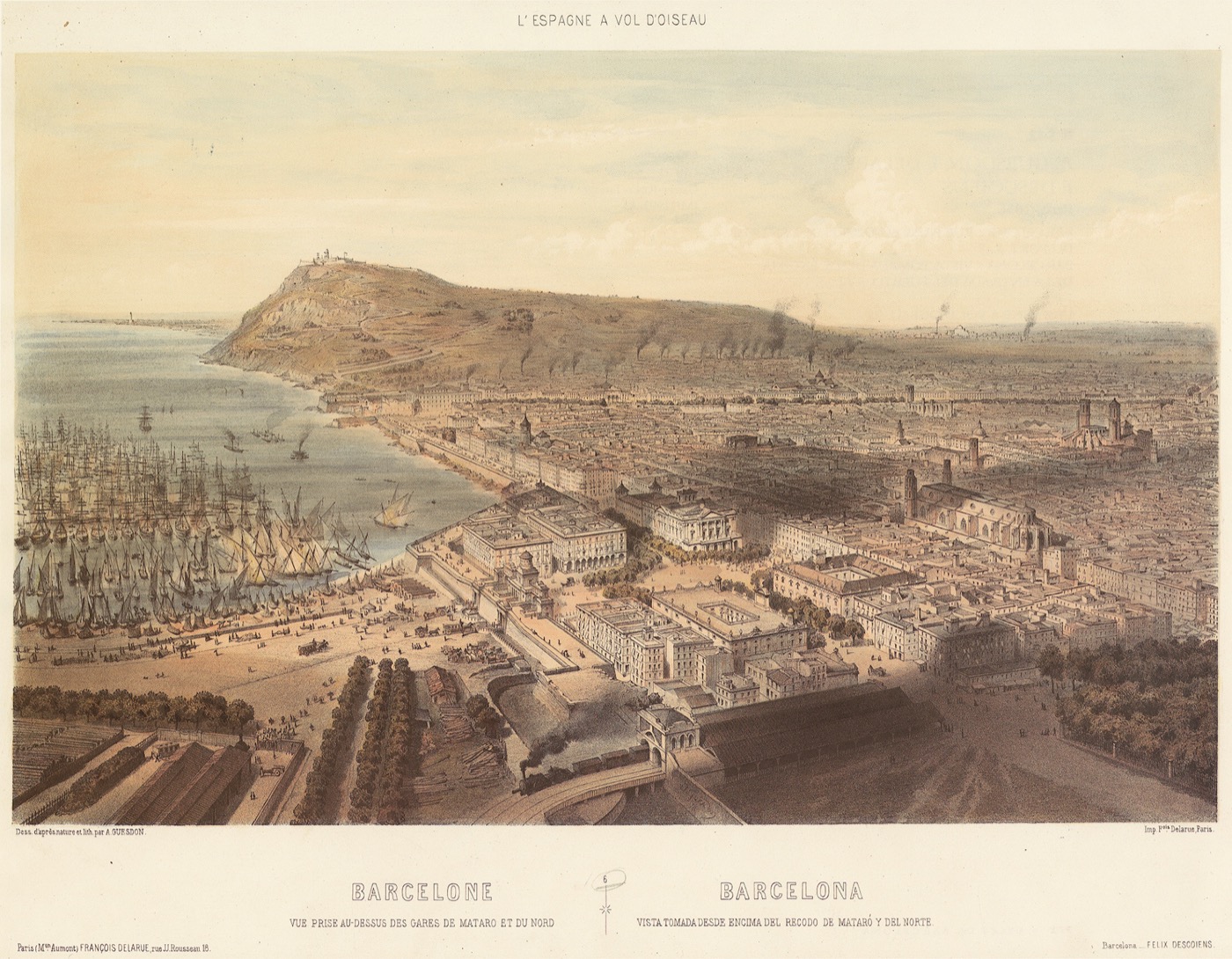
A promenade created to provide employment stood beside a fortress that dominated Barcelona’s political memory.
IN BALAGUER’S TELLING
Balaguer traces the crisis of 1799 to maritime war with England: trade and industry stalled, leaving families without work. A charity board paid workers to turn muddy ground beside the Citadel into a promenade. He then follows the campaign to demolish that fortress, built after 1714 at the expense of the Ribera neighbourhood and used to repress Barcelona. Demolition would remove a symbol of subjection and free land for the growing city; in his 1866 text, it remains blocked.
THE BARCELONA CONNECTION
The account links two stages of Sant Joan: the old promenade by the Citadel and its proposed continuation through the Eixample. The 1863 municipal naming decision likewise calls the new avenue a continuation of the existing one. The old walk lay roughly along today’s Carrer del Comerç; the modern Passeig de Sant Joan runs north from Arc de Triomf towards Gràcia. An 1888 note records the fortress’s replacement by the park and exhibition grounds.
FROM THE ORIGINAL PAGES
“A charity board was formed under Duke Agustín de Lancáster, captain general of the Principality. Among its measures to help the poor was providing work by turning the waste ground, usually muddy, between the Citadel esplanade and the houses of Bora del Rec into a pleasant promenade. This charitable purpose brought about an important improvement for Barcelona.
From «Juan (paseo de San)» · vol. 2, p. 146 · 1888 · English translation
Read Balaguer’s complete street entry WHY THIS CATEGORY?
People: Sant Joan is a dedication to Saint John, so People follows the saint rather than the promenade’s construction history. Balaguer’s old Passeig Nou is distinct from the later Eixample continuation bearing the name.
A city read through a nineteenth-century book. About our sources

 BARCELONA