THE STORY BEHIND THE NAME122 / 528
Plaça de Catalunya
In the book: Cataluña (plaza de)
THEN & NOWA popular name adopted into Balaguer’s programme, rather than coined by him. The pin marks the present square.
1860sPublic space beyond the walls
A square the city named for itself.
Balaguer included Catalunya in his scheme, but he was candid that the public and the newspapers had already supplied this name.
FROM THE VISUAL RECORD
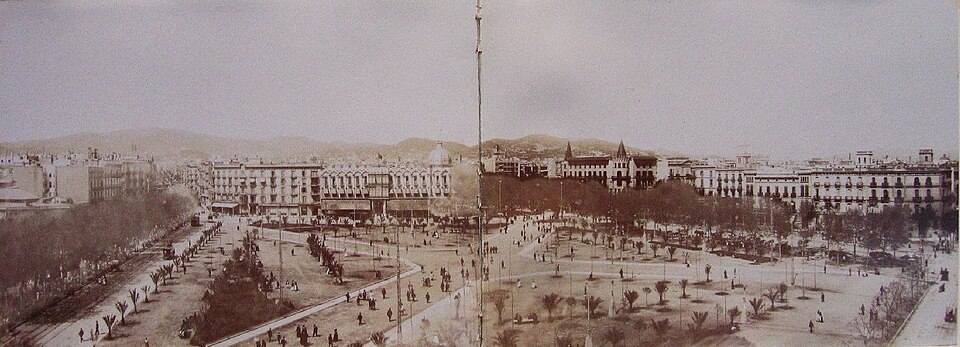
A present-day view of Plaça de Catalunya.
E. Bressanini · Public domain · Source IN BALAGUER’S TELLING
His entry describes open ground at the meeting of the Rambla, its continuation, and Passeig de Gràcia. He credits popular usage and the press with calling it Plaça de Catalunya, then discusses the struggle to secure a public square against competing property claims. The council planted trees after removing private boundary markers; the governor ordered the markers restored and required formal expropriation. The future square was still a contested claim on privately held ground.
THE BARCELONA CONNECTION
The square became the great hinge between the old city and the Eixample. Its presence in Balaguer’s programme should not be confused with an original invention of the name: he adopted an existing popular dedication. It is a useful reminder that residents and newspapers also helped make the city’s map.
FROM THE ORIGINAL PAGES
“At the end of the Rambla, before its continuation and the entrance to Passeig de Gràcia, there is now a vast stretch of land that people have taken to calling a square. Newspaper columns and popular usage have christened it Plaça de Catalunya.
From «Cataluña (plaza de)» · vol. 1, p. 264 · 1888 · English translation
Read Balaguer’s complete street entry WHY THIS CATEGORY?
Places: Catalunya names the territory; residents and newspapers supplied the dedication before Balaguer adopted it. This explains its Places category.
A city read through a nineteenth-century book. About our sources

 BARCELONA