THE STORY BEHIND THE NAME79 / 528
Plaça de la Boqueria
In the book: Boquería (plaza de la)
Crosses, an unbuilt obelisk and the Liceu.
The Pla de la Boqueria gathers several kinds of spectacle. Balaguer moves from devotional crosses to a royal monument never built and the theatre that transformed the square.
FROM THE VISUAL RECORD
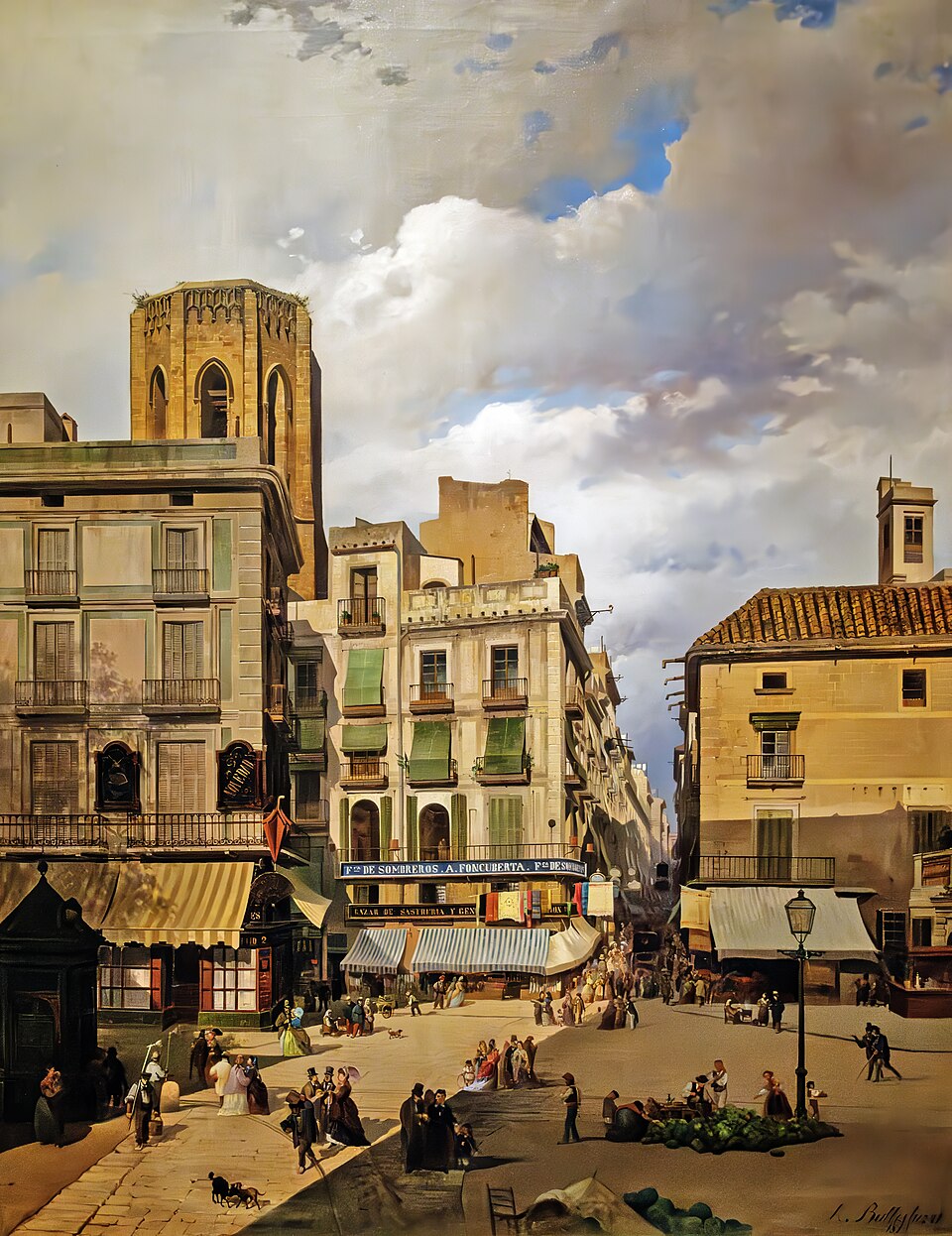
El Pla de la Boqueria, painted by Achille Battistuzzi.
Didier Descouens · Public domain · Source IN BALAGUER’S TELLING
He explains Cap de Creus through a sequence of Franciscan crosses. An obelisk planned for royal celebrations in 1802 reached its foundation ceremony but no further. His long account then follows the Liceu’s construction and opening, and the fire and rebuilding that made the theatre a civic drama of its own. Balaguer remembers attending the Liceu’s dazzling opening in 1847. A fire starting in the tailoring workshop destroyed it in 1861; rebuilding brought a new inauguration the following year.
THE BARCELONA CONNECTION
Santa Anna and Montsió connect directly with the earlier musical institution that preceded the Liceu’s move. Boqueria street supplies the gate’s history. The square is therefore both a threshold of the old city and a stage for nineteenth-century cultural ambition.
FROM THE ORIGINAL PAGES
“People call it the Pla de la Boqueria. It was formerly also called Cap de Creus, because a line of crosses placed by the Franciscan Third Order extended here along the Rambla from their convent, presumably for devotion to the Stations of the Cross.
From «Boquería (plaza de la)» · vol. 1, p. 162 · 1888 · English translation
Read Balaguer’s complete street entry WHY THIS CATEGORY?
Places: The square shares the Boqueria name with the adjoining street and former gate. Places follows that local geographic reference, rather than the Liceu or an unbuilt monument.
A city read through a nineteenth-century book. About our sources

 BARCELONA