THE STORY BEHIND THE NAME414 / 528
Rambla de Santa Mònica
In the book: Rambla de Santa Mónica
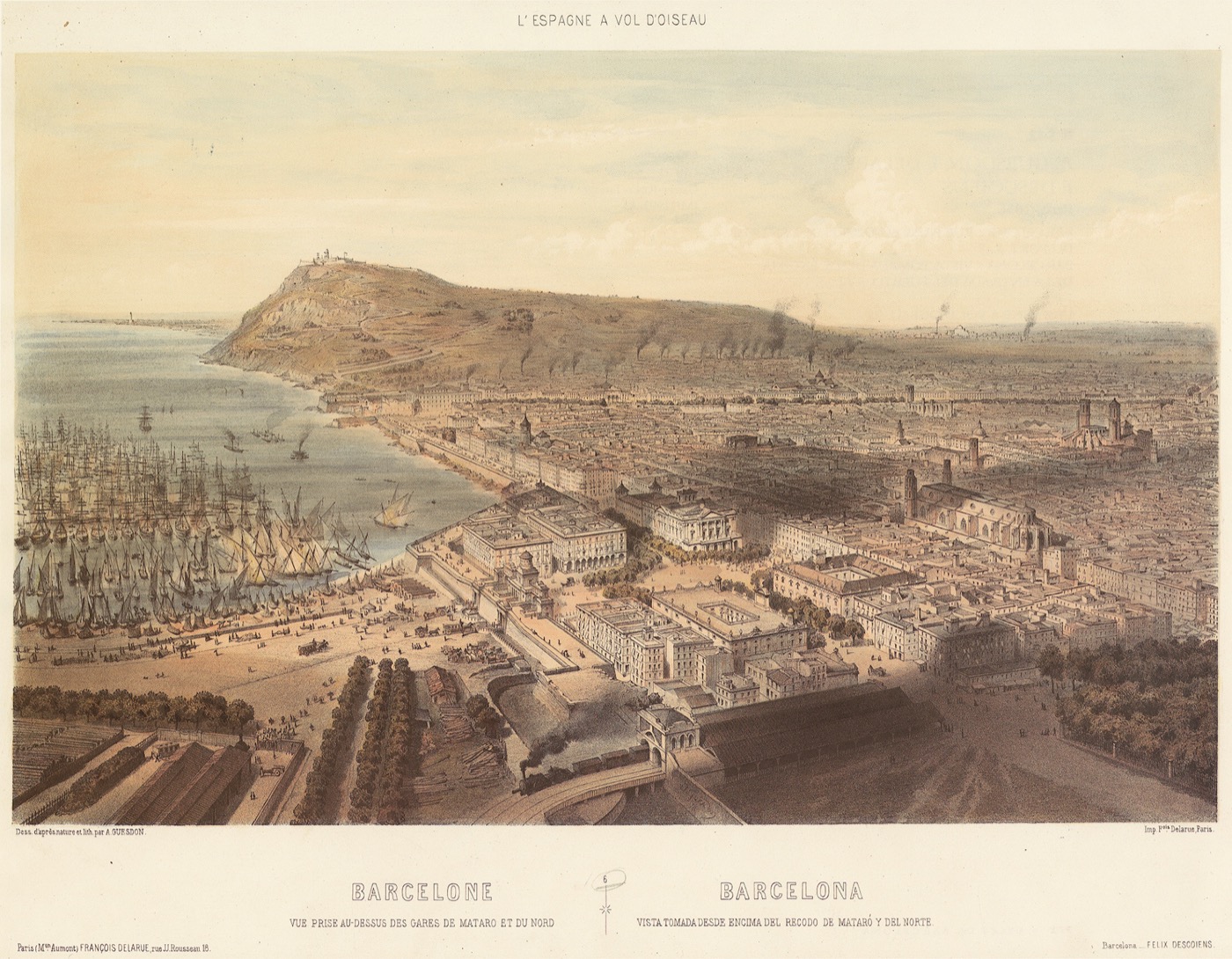
THEN & NOWThe map highlights the southern stretch of La Rambla, from the Drassanes area to Plaça del Teatre.
Shipyards, cannon and a cathedral bell
A convent gives this Rambla its name, but its story expands into shipyards, cannon casting and a cathedral bell. Balaguer turns the waterfront into a workshop.
IN BALAGUER’S TELLING
He begins with the Augustinians of Santa Mónica and then quotes a lengthy history of the Atarazanas. Royal and municipal investment built and maintained the galley yards; later military uses changed the complex. Across the way, the former cannon foundry housed the Banco de Barcelona. There, he recalls, Tomasa had been cast. Tomasa was the cathedral’s great bell, cast in 1758. The detail links the foundry’s metalworking to the city’s familiar soundscape, alongside its better-known production of weapons.
THE BARCELONA CONNECTION
The quoted bell passage joins the waterfront’s metalworking to the cathedral. The account also carries different historical layers: an 1888 footnote records the dismantling of the fortress after 1868. That military demolition should not be read as the disappearance of every shipyard building.
FROM THE ORIGINAL PAGES
“One memory of the old building must not be forgotten. In 1758 the cathedral’s great bell, called Tomasa and weighing eighty quintals, was cast there; it came out perfectly at the first casting.
From «Rambla de Santa Mónica» · vol. 3, p. 18 · 1888 · English translation
Read Balaguer’s complete street entry WHY THIS CATEGORY?
Institutions: The section was named for the convent of Santa Mònica, rather than directly for the saint. This explains its Institutions category.
A city read through a nineteenth-century book. About our sources

 BARCELONA