THE STORY BEHIND THE NAMERELATED NAME
Llobregat
Unbuilt street west of Tarragona
APPROXIMATE HISTORICAL LOCATIONApproximate study pin west of Tarragona, not a surviving street or a surveyed reconstruction. Balaguer’s described route and Cerdà’s drawn route disagree.
1864A changing plan at the city’s edge
A river on a street that never opened.
The book records a street named for the Llobregat, although the road never materialised as envisaged.
A VIEW OF THE PLACE
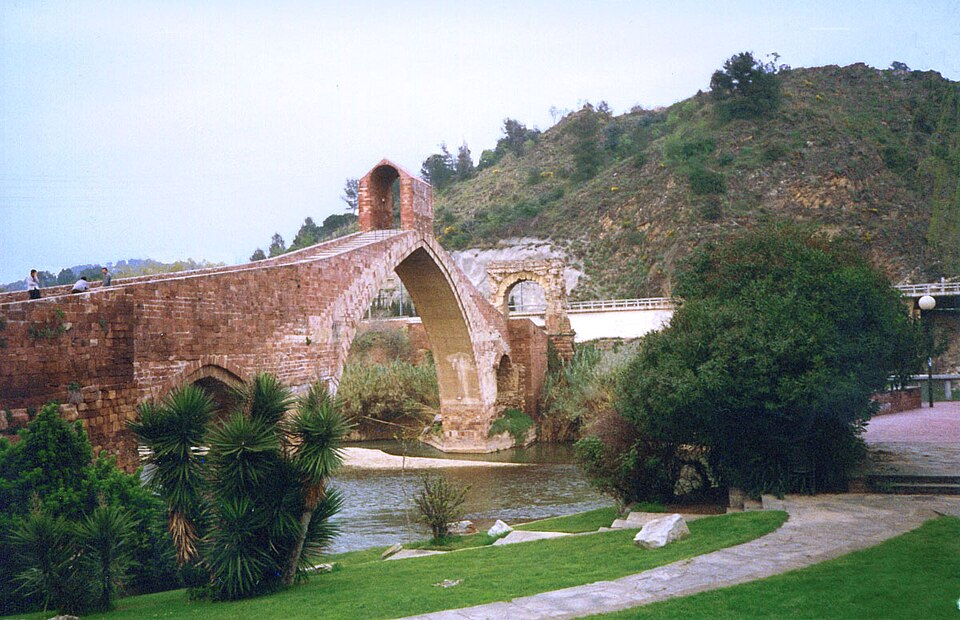
The Pont del Diable over the Llobregat at Martorell. This modern photograph shows the river commemorated, not Balaguer’s unbuilt Barcelona street.
jordi domènech · CC BY-SA 3.0 · Source IN BALAGUER’S TELLING
Balaguer describes a western edge street and explains its dedication to the river. He reproduces his own lyrical account of the Llobregat’s landscape and work: water that gives life to agriculture and movement to industry before reaching the sea. He imagines the river as a labourer worn down by rocks and machinery, finally resting in the sea. The industrial landscape becomes a meditation on human work and mortality.
THE BARCELONA CONNECTION
The council changed the projected street’s name from Manresa to Llobregat in January 1864. Later plans revised this edge of the grid, and the street was never opened in that form. It is included as related context: the book records the dedication, but omits it from Balaguer’s grouped list of his accepted choices.
FROM THE ORIGINAL PAGES
““Here is the Llobregat, so famous in our chronicles, recorded by history and celebrated in poetry, which more than once has rolled waves of heroes’ blood towards the Mediterranean. Watch its waters hurry along as though eager to reach the sea, weary of giving life to so many industries and motion to so many machines on their way.”
From «Llobregat (calle del)» · vol. 2, p. 232 · 1888 · English translation
Read Balaguer’s complete street entry WHY THIS CATEGORY?
Places: Llobregat commemorates the river, making Places appropriate. Balaguer’s projected route was not built as described; the marker does not turn the later street history into a different historical namesake.
A city read through a nineteenth-century book. About our sources

 BARCELONA