THE STORY BEHIND THE NAME82 / 528
Comte Borrell
Carrer del Comte Borrell
10th centuryThe early county of Barcelona
A count between history and legend.
Balaguer chose a count of Barcelona, then used his entry to argue about when Catalan independence began.
FROM THE VISUAL RECORD
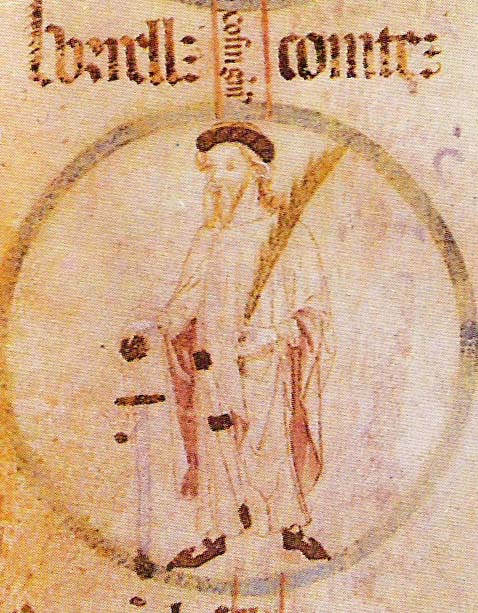
Borrell II in a medieval genealogical roll of the counts of Barcelona.
Unknown creator · Public domain · Source IN BALAGUER’S TELLING
He explicitly says the council accepted his proposal to honour Borrell. He praises the count’s support for learning and his friendship with Gerbert, the future pope. He recounts the attack on Barcelona and rejects a lurid story about the count’s death, while retaining other traditional elements of the recovery narrative. He specifically dismisses the tale of Borrell’s severed head being shot into Barcelona. His alternative has the count surviving defeat and gathering support at Manresa to recover the city.
THE BARCELONA CONNECTION
Almanzor’s sack of Barcelona in 985 was a catastrophe for Borrell II’s county. Its aftermath belongs to the gradual weakening of Frankish authority, rather than a single modern declaration of independence. This street shows both Balaguer’s desire to establish a national origin story and his willingness to question some legends.
FROM THE ORIGINAL PAGES
“A tradition, mentioned under Basea, claims that Borrell died during a renewed Muslim invasion in 993 and that his head was shot into Barcelona with a crossbow. It is a fable, like so many with which early chroniclers filled Catalonia’s history. Historical criticism, with irrefutable documents, has proved it false. Borrell died naturally in old age, late in 992, and the Muslims did not capture Barcelona again.
From «Borrell (calle de)» · vol. 1, p. 198 · 1888 · English translation
Read Balaguer’s complete street entry WHY THIS CATEGORY?
People: The street honours Borrell II, count of Barcelona. People follows that individual, while the sack of the city and independence debate supply historical context.
A city read through a nineteenth-century book. About our sources

 BARCELONA