THE STORY BEHIND THE NAME117 / 528
Casanova
Carrer de Casanova
1714The siege of Barcelona
A city’s last stand, in a name.
Carrer de Casanova honours Rafael Casanova, Barcelona’s chief councillor during the siege of 1713–1714. He led the civic militia and was wounded in the final assault.
FROM THE VISUAL RECORD
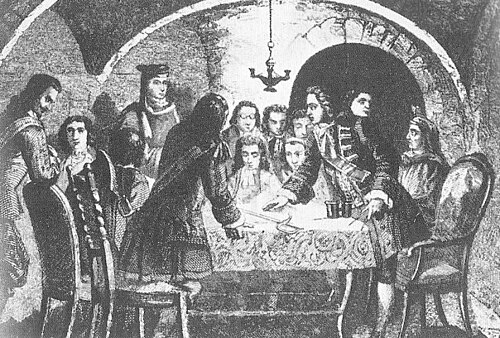
The council of war of 1 September 1714, with Casanova, Villarroel and Basset, in a later historical representation.
Unknown creator · Public domain · Source IN BALAGUER’S TELLING
Balaguer honours Rafael Casanova, Barcelona’s chief councillor during the siege. He describes his courage, his defence of the city with the civic militia, and the wound he suffered in the final assault. The defeat is framed as the destruction of centuries-old Catalan liberties. The decisive scene is at the breach by Portal Nou on 11 September 1714: Casanova is carried away unconscious as Berwick’s forces prepare to enter the city.
THE BARCELONA CONNECTION
Barcelona fell to Bourbon forces on 11 September 1714 during the War of the Spanish Succession. Casanova survived his wounds. The suppression of the old institutions after the war connects his street to Consell de Cent and Diputació; the anniversary later became Catalonia’s national day.
FROM THE ORIGINAL PAGES
“It will bear the name of Barcelona’s last chief councillor, Rafael de Casanovas or Casánova. Elected in 1713 while the city was besieged by Philip V’s troops, he displayed courage, self-sacrifice and heroism. Through the capital’s harsh trials and prolonged siege, this patriotic citizen’s zeal and care never faltered.
From «Casanova (calle de)» · vol. 1, p. 249 · 1888 · English translation
Read Balaguer’s complete street entry WHY THIS CATEGORY?
People: The street honours Rafael Casanova, Barcelona’s chief councillor during the siege of 1713–1714. This explains its People category.
A city read through a nineteenth-century book. About our sources

 BARCELONA