THE STORY BEHIND THE NAMERELATED NAME
Bailèn
Carrer de Bailèn
1808The Peninsular War
A victory felt across Spain.
This name looks beyond Catalonia to Andalusia—and to a turning point in the war against Napoleon.
FROM THE VISUAL RECORD
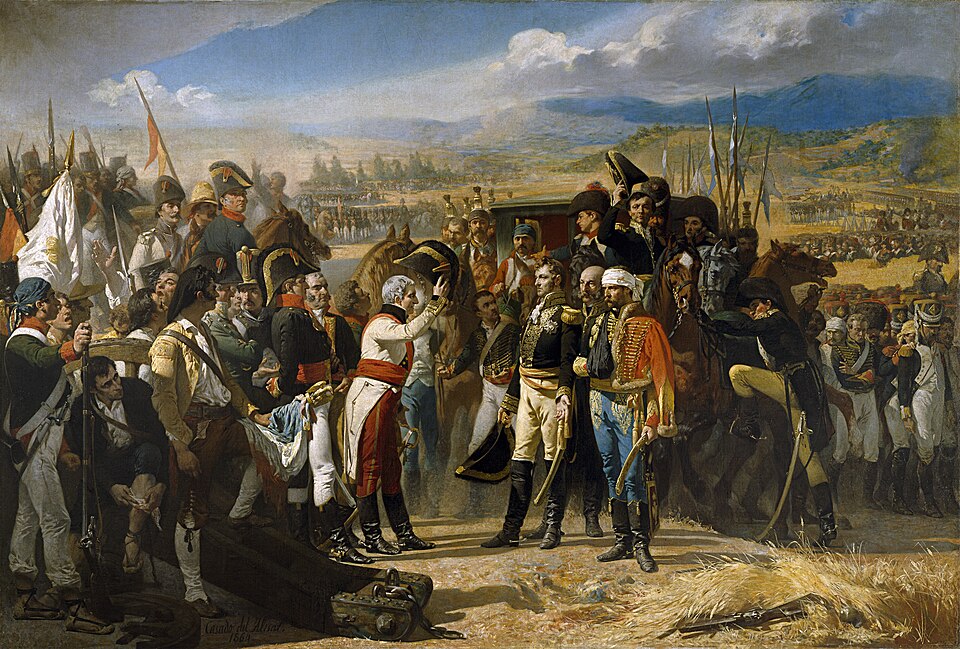
The surrender at Bailén in 1808, painted retrospectively by José Casado del Alisal.
José Casado del Alisal · Public domain · Source IN BALAGUER’S TELLING
Balaguer explicitly links Bailén to the celebrated victory over French forces in July 1808. He narrates the Spanish commanders’ plans and the fighting, presenting the defeat of Napoleon’s troops as a moment of national resistance. His account sits beside Catalan memories of the same war. He gives Reding’s division the chief credit for the fighting, while Castaños receives Dupont’s capitulation. The surrender, he explains, shook French control and forced Joseph Bonaparte to abandon Madrid.
THE BARCELONA CONNECTION
The French surrender at Bailén was a major shock to Napoleonic power and helped force Joseph Bonaparte’s temporary withdrawal from Madrid. Together with Bruc, the street places Barcelona’s own struggle within the broader history of Spain’s Peninsular War.
FROM THE ORIGINAL PAGES
“It was given this name in memory of the celebrated Battle of Bailén during the War of Independence.
From «Bailen (calle de)» · vol. 1, p. 119 · 1888 · English translation
Read Balaguer’s complete street entry WHY THIS CATEGORY?
Events: Balaguer explicitly says the name commemorates the battle of Bailén, rather than the town itself.
A city read through a nineteenth-century book. About our sources

 BARCELONA